 |
EDWARD CARPENTER, GEORGE MERRILL, and THE POLICE INVESTIGATION for INDECENCY |
| The Edward Carpenter Archive by Simon Dawson |
Carpenter Archive Home | simondawson.com | switchingview.com | Comment and Feedback
|
EDWARD CARPENTER, GEORGE MERRILL, and THE POLICE INVESTIGATION for INDECENCY |
| The Edward Carpenter Archive by Simon Dawson |
in May 1909 Herbert Gladstone MP, the Home Secretary, received a letter making a complaint of indecency against Edward Carpenter. This triggered a Police investigation, both into Carpenter's books, and into his private life with George Merrill.
These web-pages tell the story of that police investigation, reconstructed from a Home Office file still available in the National Archive at Kew, London. I think these documents have value for two reasons.
- Firstly, they help us to understand the social attitudes to homosexuality at that time; the attitudes held both by civil servants in Whitehall, and (a less-told story) the very different, and much more accepting, attitudes of farmhands in rural Derbyshire.
- Secondly, they present a more accurate picture of Carpenter's life with Merrill in Derbyshire. There are descriptions of Carpenter's attempts to seduce a young farm-hand, and Merrill's unsuccessful attempts at cruising the locals. But these are attempts that the local populace seem quite unperturbed by.
There can be a tendency to present Carpenter's life with Merrill as some form of rural gay idyll, but that is far from the case. George Merrill was a child of the slums and had been at times almost a gigolo, and some of that behaviour might have persisted into his new life. But we need to see such a life within the attitudes of the time.
This web-page is split into 3 sections
- The story of the police investigation into Carpenter and Merrill, triggered by Mr O'Briens letter to the Home Secretary.
- Mr O'Brien's other interactions with Carpenter in Derbyshire, and the stress this caused.
- A reflection on what this story can tell us about social attitudes at the time.
All the documents are contained in a file still held in the National Archives at Kew, London. "HO 144/1043/183473:INDECENT PUBLICATIONS: Homogenic Love." The complete file contains a series of smaller folders holding the papers. Each folder cover has all the handwritten notes and thoughts of the civil servants involved. Reading the civil servant's thoughts can be just as illuminating as reading the letters and other paperwork.
The letter to Herbert Gladstone was sent by a Mr O'Brien, a rubber-stamp maker who lived in Dronfield, a village a few miles from Millthorpe. O'Brien objected to Carpenter's promotion of a homosexual life and had been making life difficult for Carpenter in Sheffield for some time. He now wanted to take his campaign to London.
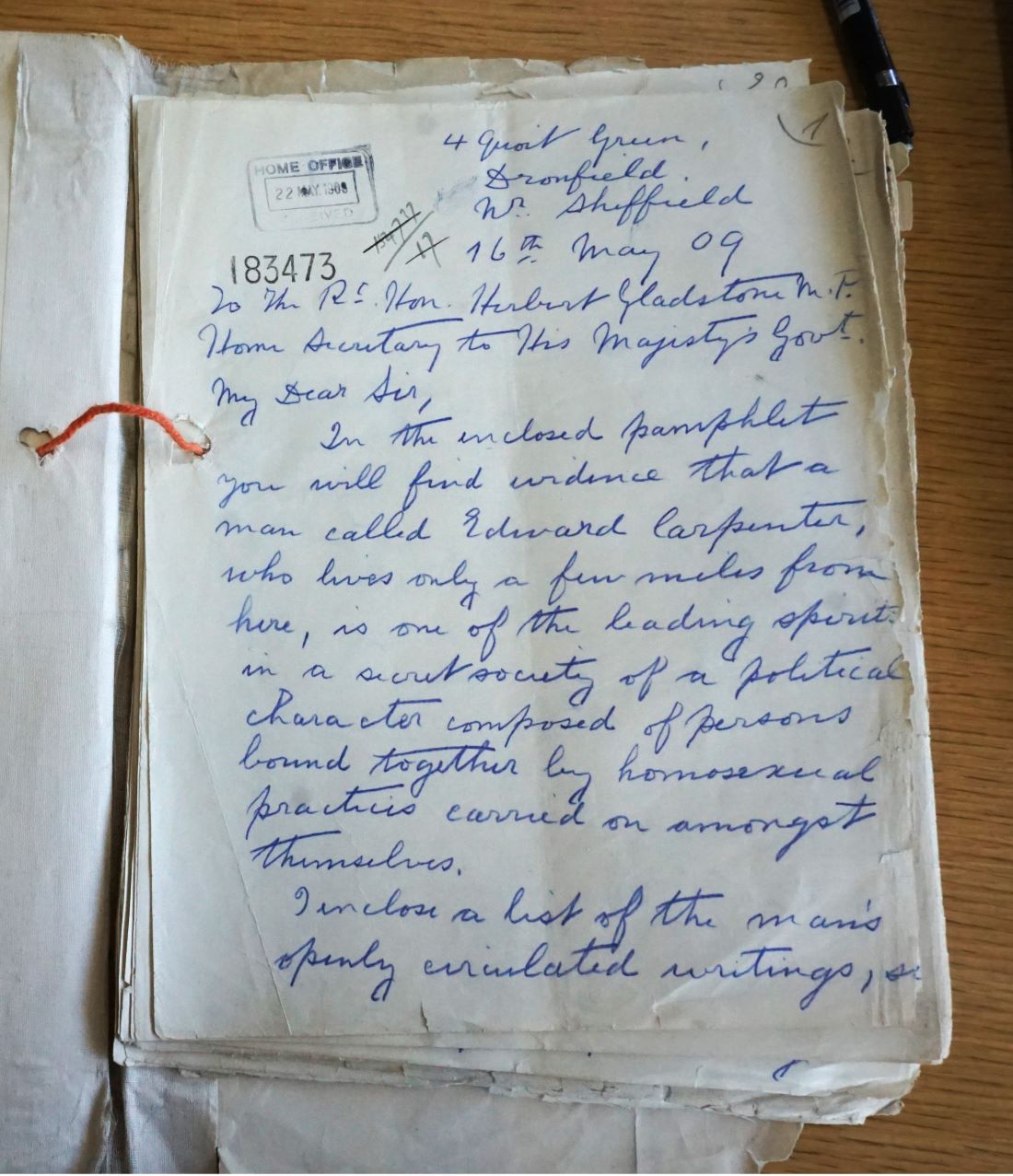
Page 1 of Mr O'Brien's original 38 page letter
The letter started as follows
My dear Sir,
In the enclosed pamphlet you will find evidence that a man called Edward Carpenter, who lives only a few miles from here, is one of the leading spirits in a secret society of a political character composed of persons bound together by homosexual practices carried on amongst themselves,
What I want to ask you before going any further is this plain question - supposing that you have reasons given for believing that this man is one of the leaders of a criminal and a secret society bent upon destroying civilisation, will it then be your duty to take action against him?
Sexual inversion spells ruin for any country, and any man who advocates it and spreads the practice of it among the people of these islands is doing infinitely more mischief to human society than the greatest criminal hung and unhung.
The letter continued for 38 more pages. See Here for a transcription of the full letter, and Here for images of the orginal manuscript.(pdf document))
The civil servants thought that the letter described possible crimes carried out both in Sheffield (where Carpenter lived) and London (where the books were published), so they sought advice from the Director Of Public Prosecutions (DPP), and the Chief Constable of Sheffield.
Folder 2 contained the Chief Constable's response, and that of the DPP
The Chief Constable's Office, Sheffield.
1st July 1909
Mr O'Brien is, I am told, a pad maker for india rubber stamps and has the appearance of a working man. He is evidently of some education and is much incensed at the writings of one Edward Carpenter, the writer of many books, list of which you enclose and to which I have added another which I have read called "The Intermediate Sex". This book or another called "Iolaus" certainly contains a chapter deprecating the severity of the law as laid down in the Criminal Law Amendment Act, 1885, (Gross Indecency between males) and the whole tone of the book is an excuse for this and worse offences. Whether there is any truth in Mr O'Brien's statement as to the existence of a Society for the advocacy of Homosexual practices I am not in a position as yet to say. Holmesfield, where Mr Carpenter resides, is in Derbyshire, and I had not finished reading his literature when Mr O'Brien called for the same. He brought me also a manuscript copy of the book called "Homogenic Love" which was I am told circulated privately. A large part of the matter contained there in is included in the "Intermediate Sex" which seems to me the worst of the printed books that I have seen written by Carpenter, who, however, so far as I have seen nowhere advocates the bestial part of his creed but seems to regard that part as an occasional accompaniment.
Director of Public Prosecutions Department, Whitehall, London.
6 July 1909
I certainly think that the papers should be referred to us officially, and if the publications complained of could be sent with the papers, so much the better. At present, there are only the extracts supplied by Mr O'Brien.
We can request the C.C [Chief Constable] to obtain specimens for us if you have any difficulty getting them. But they must be obtained before we can be in a position to consider the question of likely criminal proceedings, if the S of S desires us to take steps.
Guy Stephenson
The thoughts and reactions of the civil servants in Whitehall are recorded in various "minute notes" within the file.
On 2nd of July a Home Office minute stated:
"This is not a very helpful letter. The allegations made by Mr O'Brien are serious: (1) that Carpenter advocates unnatural vice and (2) that he is forming a society which indulges in it.
See Mr Guy Stephenson's notes within. I asked whether the DPP had heard of the case, as Mr O'Brien says that he intended to write to the DPP.
See extract from the British Medical Journal about "The Intermediate Sex" a book written by Carpenter.
And then a separate (Perhaps more senior) person gave instructions.
Obtain copies of "Iolaus" and "The Intermediate Sex" and "Loves Coming of Age". Ask C.C. Sheffield if he can obtain the pamphlet called "Homogenic Love". The copies to be obtained by an officer of the C.I.D. [Criminal Investigations Department]. Then refer the papers to the DPP for any action that is possible.
This folder also holds the copy of the British Medical Journal review of The Intermediate Sex refered to in the file note. This is worth reading to see the way that Carpenter's work was being received by some (but not all) medical journals.
Another letter from O'Brien, enclosing a document he had referred to in his first letter, a privately-published pamphet which he produced to counter Carpenter's arguments.
I am already spending between fifteen and twenty pounds of my own savings in printing and circulating pamphlets against the man. Nearly all the copies of these pamphlets are given away in order to get them into the hands of the public; for booksellers and newsagents dare not sell them. So that I am not doing this for material gain. I am doing it because I know that it is my duty before God and man to do it.
The copy he enclosed is still in the Home Office file.
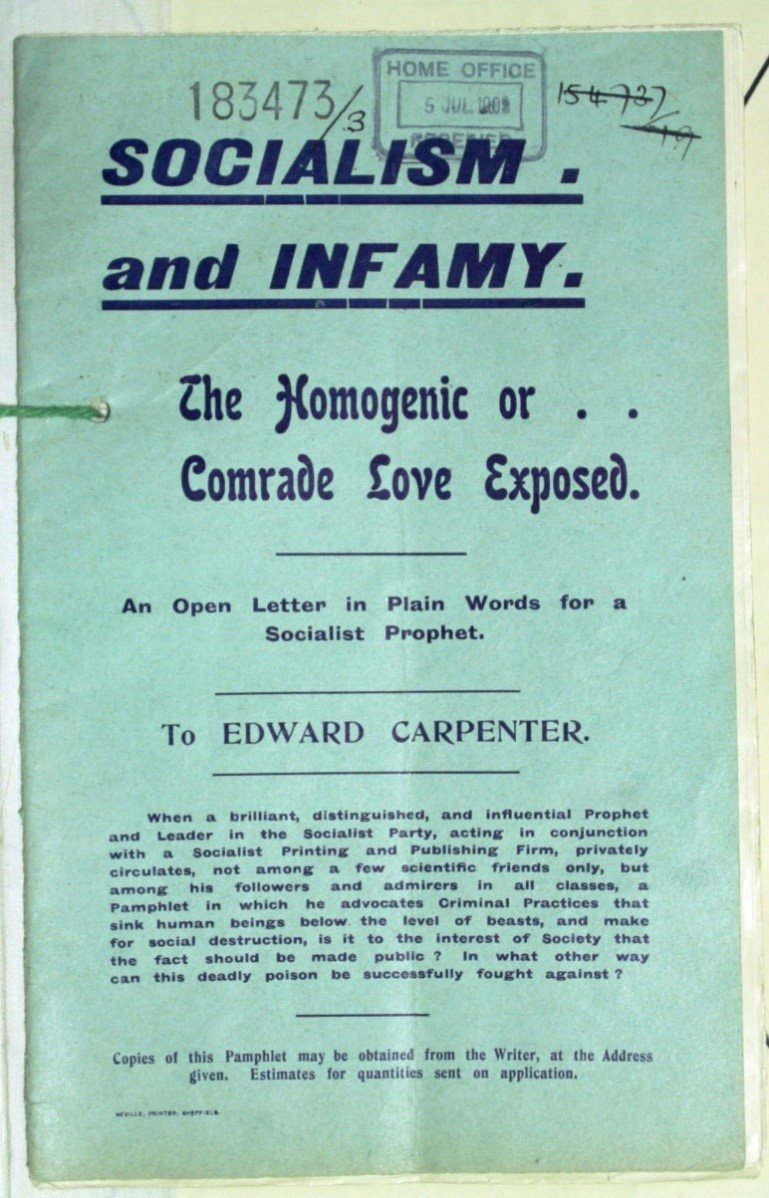
Mr O'Brien's Privately Pubished Pamphlet
See Here for images of the orginal manuscript.(pdf document)
The cover page reads as follows:
The Homogenic or Comrade Love Exposed.
An Open Letter in Plain Words for a Socialist Prophet.
To Edward Carpenter.
When a brilliant, distinguished, and influential prophet and leader in the Socialist Party, acting in conjunction with a Socialist Printing and Publishing firm, privately circulates, not among a few scientific friends only, but among his followers and admirers in all classes, a pamphlet in which he advocates criminal practices that sink human beings below the level of beasts, and make for social destruction, is it to the interest of society that the fact should be made public? In what other way can this deadly poison be successfully fought against?
The civil servant's comment read "Sir Melville Macnaghten told me yesterday that this man O'Brien is a crank".
These folders simply document how the various books were obtained to gather formal evidence. The published books were obtained direct from the publisher in London by Policemen. A manuscript copy of Homogenic Love had to obtained from Mr O'Brien by the Sheffield Police.
Homogenic Love was a privately printed, limited distribution pamphlet produced in 1894, but The Intermediate Sex is Carpenters major public work on homosexuality produced over a decade later in 1908.
This was a possible risk for Carpenter. In his major published works he had been very careful about how he referred to physical sexual acts, bearing in mind these were criminal acts at the time. But he said of Homogenic Love "only a few copies were printed and those privately, for the simple reason that the pamphlet was not intended for general circulation, but only in order to be sent to a few scientific friends, for the purpose of comparing notes and obtaining more information on a subject then new to me." . And in this pamphlet he had discussed sexual acts more explicitly (by Victorian values).
Another 7 page letter from Mr O'Brien with more details of his campaign, and chasing of progress from the Secretary of State. The civil servant notes "Papers have gone to DPP, say the matter to which he drew attention is receiving careful attention.
On 3rd August 1909 the DPP submitted his observations, having studied the books.
I have read some of Mr Carpenters productions, and, starting chronologically, I began with "Homogenic Love," which is dated 1894, and is the pamphlet which raised the fury of Mr O'Brien to the extent of a 24 page denunciatory reply, and to which my own retort would have consisted in the silence of the waste-paper basket. I glanced at "Iolaus", and at "Love's Coming-of-Age," both dated 1906, and in the latter first appears an article called "the Intermediate Sex," which is reproduced with one on "the Homogenic Attachment", and others, in the volume of 1909. Almost everything I read was nasty and, although, here and there, some effort was occasionally made to ennoble these so-called Homogenic relations, I have little doubt in my own mind what are Mr Carpenters real proclivities, and what he would preach if he only did to speak out.
If proceedings were determined upon, I think they should be founded upon the 1909 collection, not only because it is the last published, but because some of the worst features of Mr Carpenter's gospel are to be found in the appendix, which consists of extracts (said to be quotations) from some particularly advanced German, and one English, obscene writer on "Inverted Passion", but, if my opinion is of any value, I greatly doubt the wisdom of calling public attention to Mr Carpenter, or any of his works, as I hold a very strong view that the harm which not only may, but certainly will, be done by any public discussion of this the noisesome subject greatly exceeds any mischief which is possible to the readers of books, who would not buy them unless they were in search of what they contain, and who would not read them unless they had already become followers of what they affect to teach.
I agree with the reviewer in "The British Medical Journal" when he says of Mr Carpenter's writings that they possess neither scientific nor literary merit, and that his advocacy of whatever form his pleasure may take is chiefly, if not wholly, ridiculous
This advice triggered a long set of reflections from the civil servants, documented on the folder cover.
If a man writes a series of books about "Homogenic love" in which he urges the repeal of section 11 of the Criminal Law Amendment Act, he must not be surprised if bad motives are attributed to him, even if he professes to deprecate excesses.
Mr O'Brien maybe a crank, but this not dispose of the case. Some of the books have gone through several editions, and cannot fail to have done a good deal of harm: it is a pity that a well-known firm should publish them. There is no doubt a good deal to be said for not calling public attention to the matter, but these are not obscure publications, read only by a few. There has already been a severe review in the "British Medical Journal". The case recalls that of Havelock Ellis.
It is alleged that Carpenter practices as well as preaches.
Send papers to the Chief Constable of Derbyshire, for confidential enquiry and report.
And on 13th August another civil servant responded
Yes, it is the charges of indecent practices and incitement to such practices that should be specially bought to his notice, and the enquiries should be made very discreetly.
(It is most unfortunate that the DPP cannot see his way to do anything to check the publication of this mischevious filth in Mr Carpenter's books. It must do a great deal of harm - The more that the grosser side of the subject is kept discreetly in the background. The difficulty of dealing with such stuff by prosecution seems to indicate that this censorship, so far from being withdrawn from the drama should be extended to literature.)
The instructions to the Derbyshire Chief Constable were issued on 24th August
Home Office, Whitehall
Confidential
Sir,
I am directed by the Secretary of State to forward to you herewith communications which he has received from one Mr O'Brien of Dronfield near Sheffield, with regard to Edward Carpenter the author of "Homogenic Love" and other books, and to ask you to favour him with a confidential report on the matters therein referred to and particularly on charges of indecent practices and of incitement to such practices, which appear in the letter of July 1 addressed by Mr O'Brien to Counsellor Whiteley. It is important that the necessary enquiries should be made very quietly and discreetly.
The letter to Counsellor Whiteley referred to is not in the file, although other letters by O'Brien are there, and they are all very similar in tone and content to the original letter dated 16th May.
The Chief Constable's reply was received a couple of week's later.
I beg to forward a report from Supt. Andrew of this Force, dated 26th June last. I did not see my way to take any action on this report because the alleged offences took place such a long time ago.
You will observe that the same names are mentioned by Mr O'Brien in his letter to the Superintendent and in his letter to you.
Observation is being kept on the Merrill and Carpenter but I am anxious to get a strong case before taking any proceedings.
Supt. Andrew's report is in three parts, a report on Andrew's own investigation, a statement by a Mr George Levick, and a copy of a letter from O'Brien to Andrew naming potential witnesses. See Here for a transcription of the various documents, and Here for images of the orginal set of statements (pdf document). They are fascinating, and help to give a more nuanced picture of Carpenter and Merrill's life in Millthorpe.
Although the report from Sheffield described homosexual behaviour by Merrill, and possibly by Carpenter, it was decided that there was not sufficient evidence to take proceedings forward.
28 August 1909, S of S Minute Note
Most of the statements about Merrill relate to incidents which occurred several years ago. There is no direct evidence against Carpenter; but Merrill is his servant, and the two live together alone.
The statements within make it clearer even than it was before what are the views underlying Carpenter's books.
In returning these papers the Chief Constable should be told that S of S would be glad to know if any fresh evidence is obtained. But first DPP to see.
There is also a note dated 31st August, which I presume is by the DPP, as it is in same handwriting as Guy Stevenson above.
Seen. No action possible upon the statements taken.
S of S staff then documented what actions to take to bring the current investigation to an end.
1 September 1909,
? Write to Chief Constable as proposed, keeping copies of the enclosures.
Return Mr O'Brien the enclosures as desired, and say S of S has made a careful enquiry, and consulted the DPP, but on the information now before him does not see his way to take any action.
The final document in the file is a letter from the Home Office to the Chief Constable of Derbyshire dated 6th September
Sir,
I am directed by the Secretary of State to thank you for your letter of the 27th ultimo in the case of Edward Carpenter and to return of the enclosures contained therein.
The S of S has referred the papers to the DPP who agrees that at present there is no evidence present to justify proceedings - the incident is however one of considerable importance, and you should keep a discrete watch as is reasonably practical, on the proceedings of the persons concerned.
If and when any fresh evidence is obtained in the case, the Secretary of State would be glad to be informed.
I am, Sir, Your obedient servant.
While the police investigation may have posed the greatest danger to Carpenter and Merrill, it's quite possible they were entirely unaware of it. O'Brien's more direct attacks on Carpenter in Derbyshire, however, were impossible to ignore - and were causing Carpenter considerable stress.
This section draws almost entirely from Sheila Rowbotham's biography, Edward Carpenter: A Life of Liberty and Love.
Rowbotham describes O'Brien as a member of the right-wing Liberty and Property Defence League, a man with an obsessive hostility to both socialism and homosexuality. In 1908 he began speaking out against Carpenter at meetings in and around Sheffield. By 1909 he was distributing his pamphlet Socialism and Infamy in the villages near Millthorpe, which luridly described Carpenter's visitors and their alleged "morbid appetites, naked dancing, corruption of youth, paganism and socialism."
Carpenter's friends tried to reassure him that O'Brien was a crank and that the storm would pass. But privately they knew the real problem was George Merrill, whose behaviour - as detailed in the police report - was widely known locally. There were also worrying signs that O'Brien was beginning to attract some support.
It was an exceptionally difficult time for Carpenter. He kept a calm public face, reaching out diplomatically to local newspapers and community figures to defuse the tension. But privately he was caught between friends who were openly critical of Merrill's conduct and his own deep love and loyalty toward his partner.
Then came a stroke of luck. In September 1909, just as O'Brien appeared to be gaining momentum, he overreached. He accused the local vicar, Reverend Bradshaw, of siding with Carpenter - and Bradshaw wrote to tell Carpenter that the whole parish was outraged, with O'Brien now calling Holmesfield "the Sodom of Derbyshire." The populist campaign had badly misfired. Rather than isolating Carpenter, O'Brien had united the village behind him.
O'Brien's campaign limped on for a few more years, but his personal life was unravelling. His wife eventually left him, worn down by his behaviour. In 1913 he issued further pamphlets attacking the women in his own family, alongside what he called "the Socialist Prophet of Sodom and Gomorrah, Edward Carpenter." He was later charged with assaulting a woman who had given shelter to his mother and wife.
One can't help noticing the parallels between this and our modern life. It's interesting how many of today's right-wing activists and campaigners against immigration, socialism and homosexuality have convictions for domestic violence against women.
The episode had strained some of Carpenter's relationships with local people, but he and Merrill worked hard to repair them - setting up a youth club, organising plays and drama, and rebuilding goodwill through a quiet but determined effort to be good neighbours.
The above two sections have been structured as factual narratives of events, based on the documents available. But the following section is more of a personal reflection on what I think these documents can tell us about homosexual history.
When doing any investigation into homosexuality, we always have a huge amount of documentary evidence left to us by the elite in any society. The elites are often male and patriarchal and the surviving documents will reflect such values.
We may have some documentary evidence from a homosexual subculture, but such evidence may be "coded" by the semi-hidden assumptions and language of that subculture, and will need careful interpretation. Such interpretation is often best done by people who are themselves homosexual.
It is exceptionally rare, however, to get good evidence of homosexual behaviour from working-class cultures in history. Written documentation may not have been created, or be lost through the exigiences of poverty. Often the only records we have are when working class people interact with the elite, either through the criminal courts or through romantic attachment (whether motivated by love or commerce). But even these records will be in the voice of the elite person, and the working class person's voice will be silent (as in Carpenter's biography of Merrill).
In my own work I label these "top-culture" (the elite), "sub-cultures" (sexual minorities) and "unrecorded cultures" (working class - amongst many other cultures). The key thing to recognise is lack of evidence of something happening is not evidence that the thing never happened. Working-class homosexual life must have been there, but we know very little about it.
This police investigation evidences the attitudes of the patriarchal elite in Whitehall, something we know a lot about already. But the story of George Merrill gives us a rare and valuable chance to explore one late Victorian working-class homosexual life, and through him a window into working class rural homosexual culture. There are three relevant documents about George on this website.
The police report and the minute notes reflect attitudes toward homosexuality that were common at the time.
Among the Whitehall elite, even the more liberal-minded tended to view homosexuality as a regrettable pathology - a problem to be managed by doctors and the criminal law. Some accepted that medical professionals might need access to books on the subject, but felt such knowledge should be tightly controlled and kept from the general public. One reviewer of a German publication argued it should never have been translated into English, so that only the "right sort of person" - someone who naturally read German - could access it. Better still, he suggested, it should only be available in Latin.
Rowbotham notes that some medical journals were beginning to offer more sympathetic reviews of publications like The Intermediate Sex. But this was far from universal. In one letter, O'Brien quoted the editor of the British Medical Journal: "I am glad to find that we may reckon on your support in our attempts to combat a serious social evil. We want to kill, not merely scotch, the snake." The BMJ review and O'Brien's letters reveal how seriously - and aggressively - this mission was pursued.
More revealing, perhaps, is what Superintendent Andrews' statement tells us about attitudes among the rural working class. What stands out is the near-total absence of the strong moral condemnation found among the elite.
Recent scholarship suggests that while Victorian upper-class society was taught to regard homosexuality as a moral failing, working-class culture often took a very different view. Before reliable contraception, and in a world where young men had limited access to women, same-sex relationships - whether for companionship, physical intimacy, or both - were relatively common and accepted. Many of the men Merrill encountered may themselves have had, or may still be having, same-sex relationships alongside any heterosexual lives. Havelock Ellis captured this in his 1897 book on homosexuality, quoting a correspondent identified as "Q" (believed by Rowbotham to be Carpenter himself):
Among the working masses of England and Scotland, "comradeship" is well marked, though not (as in Italy) very conscious of itself. Friends often kiss each other, though this habit seems to vary a great deal in different sections and coteries. Men commonly sleep together, whether comrades or not, and so easily get familiar. Occasionally, but not so very often, this relation delays for a time, or even indefinitely, actual marriage, and in some instances is highly passionate and romantic. There is a good deal of grossness, no doubt, here and there in this direction among the masses; but there are no male prostitutes (that I am aware of) whose regular clients are manual workers.
Merrill's experience around Millthorpe fits this picture well. His attempts at cruising may sometimes have been unwelcome, but they prompted no formal complaints. They were accepted as simply part of who he was - much as another man might be known for never buying his round at the pub. His advances were tolerated within a broader live-and-let-live outlook. Of course, we will never know how many men were glad to accept Merrill's advances. That is unrecorded history - but one must assume they existed.
The introduction to O'Brien's Socialism and Infamy pamphlet offers a useful window into how Carpenter was seen by his contemporaries. O'Brien describes him as a "Socialist Prophet" - "a brilliant, distinguished, and influential prophet and leader in the Socialist party." This was an accurate reflection of Carpenter's standing at the time. A loose modern equivalent might be someone like Bernie Sanders, Zack Polanski, or Zohran Mamdani: figures regarded as dangerous radicals by the establishment, yet revered by younger generations for their socialist, communitarian, and environmental vision; figures who use social media to bypass traditional (and biased) mainstream channels. Carpenter occupied much the same role a century earlier, using books, articles, and lecture tours to inspire a wide following - particularly among younger working and middle-class readers. Two contemporary descriptions capture this well:
"by the middle 90s Carpenters influence was incalculable. Especially among the young, who found in Carpenter a man possessing the strength to live what he taught."
and
"Carpenter was the Prophet of Socialism, in whose Towards Democracy the soul of the Labour Movement found expression, before as yet there was a Labour Movement."
It was Carpenter's huge influence, especially amongst the young, which made his promotion of homosexuality appear to be so dangerous to the British establishment. (See my Edward Carpenter Video Biography hosted on my switchingview Website/YouTube channel).
Merrill's story is more complex, and I'll admit to holding conflicting feelings about it.
It's well documented that many upper-class homosexual men sought escape into other cultures, where attitudes toward same-sex relationships were far less constrained. T.E. Lawrence escaped into Arabia and then into life as an ordinary soldier. Wilfred Thesiger immersed himself in Arab culture. Joe Orton and Kenneth Williams did the same, decades later. Could Carpenter's move northward into working-class life have been partly motivated by the same impulse? Merrill's freedom from social inhibition may have been exactly what Carpenter was seeking - an attitude embodied by the gamekeeper Scudder in E.M. Forster's Maurice, and the gamekeeper Mellors in D.H. Lawrence's Lady Chatterley's Lover, both said to have been inspired, directly or indirectly, by Merrill himself.
There is a temptation to describe Carpenter and Merrill's life together as a quiet rural idyll - partly out of a wish to celebrate them as an early, openly gay couple who made it work. But their relationship was complicated, and of its time, and that complexity deserves honest acknowledgement.
Although their friends may have known the truth of their relationship, Carpenter was careful not to give any official clue to suspicious authorities. Merrill was registered as a servant with the local authority, and as a secretary on their passport. And whilst modern constructs about gay relationships often foreground equality, late Victorian men such as Carpenter often adopted constructs based on an inequality of age or class, probably derived from their Classical Greek studies of texts about the lover and his beloved. Carpenter's poem Hafiz to the Cup-Bearer (written shortly after he met Merrill), and Merrill's letters to Carpenter, indicate something of this mindset.
Looking at Merrill's earlier life, and at accounts of how the two men first met on the platform at Dore and Totley station, one is left wondering: was this a genuine love match? Or, given Merrill's past, was it a deliberate attempt to cruise a wealthy man, as he had done at times before? Many of Carpenter's friends were deeply suspicious of Merrill's motives and predicted trouble. But Carpenter clearly loved him, for whatever he brought to his life - and the rest is history.
I find myself genuinely unsure. Did Merrill manipulate Carpenter? Was it something more tender? Perhaps both at once. Or perhaps Merrill was simply a man out of place - behaviour that would have passed unremarked in the anonymity of Sheffield becoming problematic once he moved to a small village. Whatever the truth, it's hard not to feel some sympathy for a man making the best of a difficult start in life - and in doing so, providing loving companionship to Carpenter for nearly forty years.
What matters is that we engage with these stories honestly, so we can understand how Merrill, Carpenter, and other gay men actually lived in Victorian and Edwardian England - rather than projecting onto them a romanticised ideal shaped more by our own hopes than by their reality.